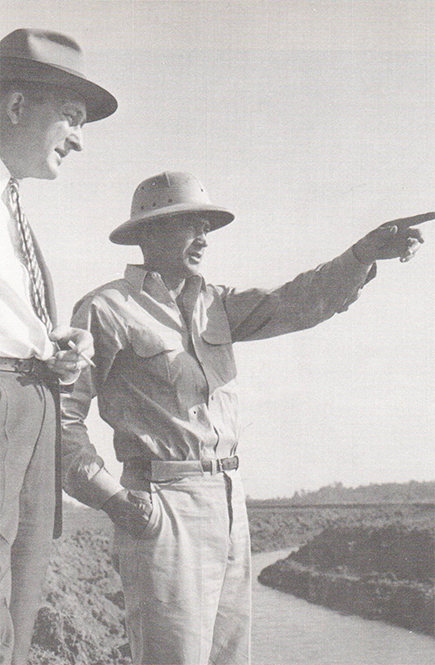
The enterprising Delta farmer has continually sought ways to make more profitable use of his land. Rice was first introduced to the Mississippi Delta in 1948 when producer Rex Kimbrel took a risk and planted 300 acres of rice on heavy clay soil north of Greenville. The harvest yielded 2,700 pounds per acre, and interest in this new prospective crop swept across the Delta where rice acreage expanded rapidly.
The promise of rice as a new Delta crop prompted the Delta Branch Experiment Station to acquire additional land suitable for rice production. Initially, much of the rice knowledge came from neighboring states, where some of the cultural practices did not prove adaptable to the Delta. To customize varietal research and cultural practices for rice in the Delta, a small research project was begun at the Delta Branch Experiment Station in 1950. Rice production continued to increase, and by 1951, 26,000 acres of rice were harvested locally, valuing $3,058,000.
In 1981, rice production reached record levels, with 337,000 harvested acres in the state. One area of rice research in the early 1980s focused on irrigation practices, with new, more successful methods discovered. The rice research at the Station continued to reveal more efficient ways to utilize the Delta’s abundant water supply. The increase in rice production also caused agricultural economists to evaluate the efficiency of new production practices. Since there was much interest in on-farm drying and storage facilities, studies involving the cost of owning and operating these on-farm facilities provided additional profitability for the rice producer.
-100 Years of Agricultural Research, The Delta Branch Experiment Station (2004)